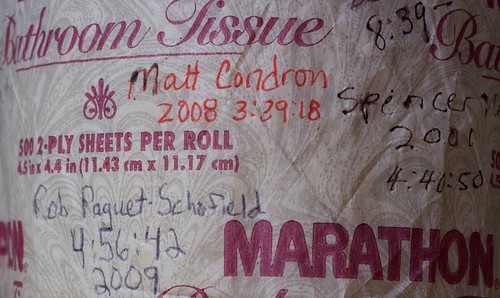
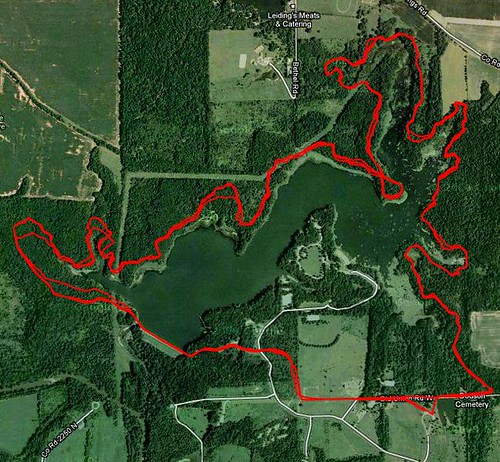
Yesterday I ran Riddle Run 11. This is a 28 mile ultramarathon held each January. You may recall that I was the first finisher at Riddle Run 10 last year, for which I was awarded the traveling trophy (a roll of toilet paper signed by the previous winners).
Last year I was in great shape, but the course was covered in 4" of mushy show. I must have ended up running twice the official distance just from my feet slipping around so much. I ran nice and easy, finishing in 4h56m. It just so happened that nobody else ran faster, so I was first.
This year I knew I wasn't in quite as good shape as last year, but we only had about 1" of snow on the ground (which, while not ideal, is much easier to run through than 4"). I was really disappointed with my run at Tecumseh last month, so I had something to prove to myself.
I started the run very easy. I picked a big group to run with and we talked and laughed the entire first (of seven) four-mile loop. I'm notorious for starting too fast and (like last year's Rockford marathon) I made damn sure not to make that mistake yesterday.
The second loop I picked up the pace a little bit, from 9:30 to 9:00 to 8:30. By the end of the second loop I was running slightly faster than 8:00 miles and I would stay at this pace for the next 12 miles or so. At the end of each loop I stopped by my car for 30-60 seconds to drink some gatorade and water and to grab a bite to eat.
"Ultras are just eating and drinking contests, with a little exercise and scenery thrown in."
-Sunny Blende, nutritionist (from Born to Run)
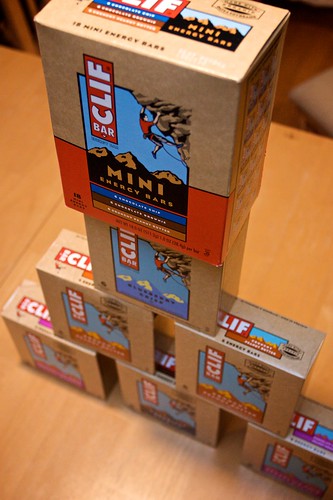
Over the course of 28 miles I ended up eating four mini Clif Bars, a banana, two flasks of chia gel, a bottle of Gatorade, a bottle of water, and six Enduralytes (electrolyte pills)... and it still wasn't enough. My stomach was growling the last eight miles.
During the middle part of the run the miles just flew by. Each time I finished a lap I thought to myself, I was just here a few minutes ago. I was flying and the miles were coming so easily, but it wouldn't last forever.
I started to tire around mile 20. I quickly realized could no longer maintain sub-8:00 miles and I started to question whether I would finish at all. After eating I started my 6th loop much slower and I felt a lot better. I could definitely finish by running closer to 9:00 pace.
The last two laps were a bit of a slog, but I kept shuffling along, and I never stopped to walk (a feat I've only accomplished one other time, at Rockford). Three miles from the end a fellow runner Jason and his friend absolutely flew past me. I had last seen them exactly 20 miles earlier when I had just started to pick up the pace. It was amazing how strong they were finishing. I crossed the 26.2 mile mark at 3h46m, making this my third fastest marathon ever. On a trail. Covered in snow.
Last year I finished the run with mile 28 being my fastest. This year it was my slowest (the second slowest this year was the first mile). I dragged myself across the finish line in 4h04m, my fastest Riddle Run by more than a half hour, and a full 50 minutes faster than last year (almost two minutes per mile!).
Jason and his friend had gained six minutes on me in the last three miles, and they finished first. Matt and another guy were in between us. It's rather amazing to me that the first five of us finished within six minutes of each other after such a long run.
So that was my fourth Riddle Run, my fifth ultra-distance run, my seventh trail marathon/ultra, and my 11th marathon or beyond. Of all those runs, this one was the third fastest, yet at the same time probably the easiest for me. Considering I didn't do any training specifically for this run, and I didn't taper at all, I guess I'd have to say that I'm in a little better shape than I thought I was. That's a good sign.
If you don't have answers to your problems after a four-hour run, you ain't getting them.
-Born to Run
The Tecumseh Trail Marathon is coming up on December 5. Rather than the typical 16-week training program I would follow for a big road marathon, I adopted the less conventional 5-week crash course training program for this race.
I ran this race last year and it was incredibly difficult. The course is very hilly, with thousands of feet of ascents and even more of descents (it's a point to point course with a net loss in elevation).
I feel better on the long runs than I ever have before. This is fairly surprising given that I took the summer off from running and ran only short distances in the early fall. By mid-October I decided to push myself and run 11 miles (the farthest I had run in 5 months) on the Allerton trails and I was sore for a week. Somehow things just magically came together.
Since the Allerton Trail Race I've alternated long runs at Lake Mingo and Forest Glen, running 14.2 at Mingo, then 16 at F.G., then 21.3 at Mingo, then 16 at F.G. These are 2-3.5 hour long runs on fairly challenging trails, yet the miles have passed so easily for me... easier than they ever have before.
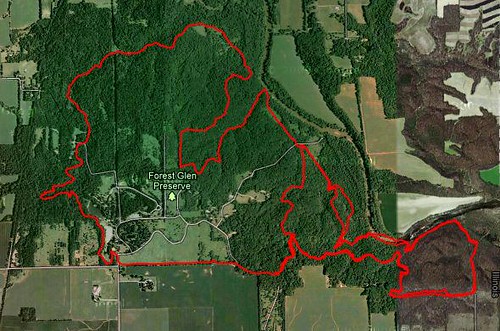
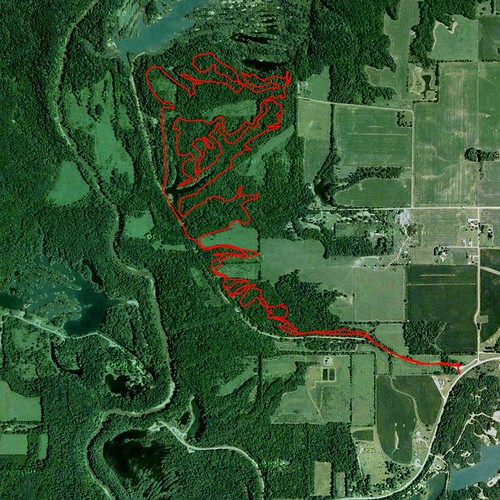
Forest Glen 11 mile loop and 5 mile loop
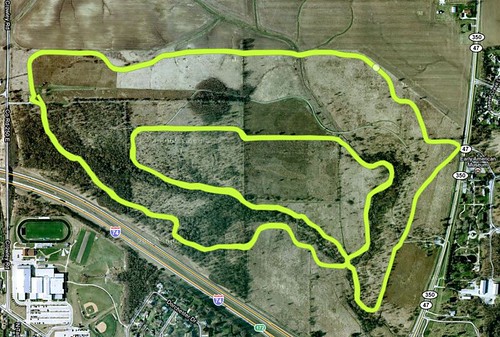
Lake Mingo 7.1 mile loop
The past month or so I've been paying a lot more attention to my diet, eating a lot more higher quality, natural, unprocessed food--lots and lots of vegetables and fruits. My blood pressure has dropped noticeably, I've shed a couple of excess pounds, and I don't feel like crap after meals.
I've drawn a tremendous amount of inspiration from reading the book Born to Run. It's incredibly well written and covers everything from history and science to tips on form/training/nutrition/life, all while building up to the story of the "greatest race the world has never seen." I couldn't put the book down and when I finished I read it again. I haven't felt this hungry to be out on the trails since I was in high school.
The only thorn in my plans so far has been, literally, a thorn in my foot. 9 miles into my 21 mile run last weekend I stepped on a thorn, which isn't all that rare. This thorn, however, went all the way through my shoe and into my left foot. I felt the pain and immediately hopped on my right foot until I could slow down and stop. At first I thought it was just poking me so I gave it a tug and the thorn broke off flush with the bottom of my shoe. Then I tried to take my shoe off, but that required sliding my foot out, which I couldn't do because the thorn was still stick in both my foot and my shoe.
After about five minutes of trying to get a grip on the fraction of a millimeter of the thorn still sticking out I eventually just shoved a stick in my shoe (like a shoe horn) and pried my foot away from the shoe enough to get the thorn out and slide my shoe off. It was fairly unpleasant. With the shoe off though I was able to pull the thorn out of it and continue on down the trail. I didn't know whether I'd be able to walk, let alone run. It was tender for a couple hundred meters then I forgot all about it. I ended up running 12 more miles before calling it a day.
I thought my problems were all over, but after the 45 minute drive home I couldn't even walk on it my foot hurt so bad. I limped all day Monday and even stayed home from work on Tuesday. By Wednesday I could walk short distances, and by Thursday it felt just barely not-horrible-enough to walk to work. By Friday the pain was virtually gone.
Now that this scare is over I'm headed full steam ahead. It's still early to tell what's going to happen at Tecumseh, but I feel pretty good about it.
"Don't fight the trail," Caballo called back over his shoulder. "Take what it gives you."
-Born to Run
"Celebrate the independence of your nation by blowing up a small part of it."
My friend John and another coworker of mine were helping out with the fireworks show at Miller Aquatics and Health Club, just outside of Homer, on Wednesday. They invited us out to watch, though I didn't think I'd be home from my bike ride in time to make it out to Homer by 9 pm. Fortunately, I was home in time and we decided at the last minute to go.
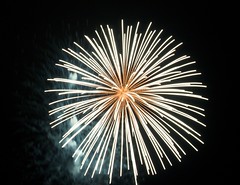
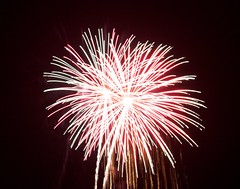
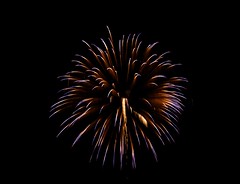
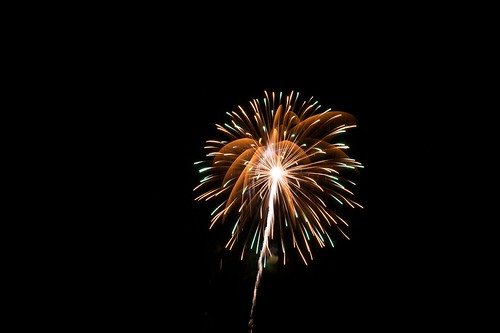
The show was really well done and we sat very, very close to the launch site, so we had a different perspective than I've ever had for fireworks before. As you can imagine, I brought my camera to try to get some good shots of the fireworks. It took some getting used to, but I think by the end I started to get some good photos.
As I write, Melissa & I are at Chicago O'Hare airport waiting on our (delayed) flight to San Francisco. I am attending Apple's Worldwide Developer Conference (WWDC) this week. Melissa is along for the ride.
Since I started working full time as the primary Mac OS X developer of Mathematica at Wolfram Research in 2001 I have attended this conference every year except 2006. That year the conference was scheduled (Apple has been really bad lately at waiting until the last minute to schedule this huge conference) during the week Melissa & I were moving to Nicaragua, so I missed out. The conference is exciting every year, but none was more exciting for me than 2005 when I (along with my boss Theo Gray) participated on stage during Steve Jobs' keynote address.
Note: some of this information was confidential at the time, but is now mostly publicly known. I can't imagine any of the details I mention below would still be considered sensitive information.
On Wednesday night the week before WWDC I got a call at 9:30 pm from Theo. I was almost ready to go to bed. He asked if I would be able (and willing... but more able :) ) to fly to California at 6 am the following morning. I suppose I could, but why? Theo went on to tell me that Apple had a super secret project and they wanted our help, but he wouldn't tell me what the project was.
I have since learned that he actually knew what the project was at the time of that call, but he couldn't tell me. Stephen Wolfram, the founder and president of Wolfram Research wouldn't sign off on the idea until he knew what was going on. Steve Jobs told Stephen Wolfram & Theo what the project was and they agreed to take part... but they couldn't tell anyone else.
I spent the next two hours packing (including the Dahon, my folding bike at the time) before going to bed. Early the next morning I arrived at the Champaign airport. Apple purchased my one-way ticket to San Jose (by way of Chicago). An Apple limo picked me up at the San Jose airport and drove me straight to Apple's campus in neighboring Cupertino. Luggage still in hand I entered 3 Infinite Loop (I think). A few minutes later I was in a meeting with Ron Okamoto, Vice President of Worldwide Developer Relations.
Ron told me what the secret was, that Apple was building a Mac which used an Intel x86 processor. They had ported all of Mac OS X to this new architecture (Darwin, the open source core of Mac OS X, already ran on x86). They intended to demonstrate this new x86 version of Mac OS X on Monday's WWDC keynote. They wanted do demo a 3rd party application running on the x86 Mac. They chose Mathematica to be that 3rd party application. He asked me if I thought it would be possible to get Mathematica up and running on Mac OS X Intel by Monday.
Uhhhh.
That's a potentially huge task. Our code is fairly portable (at the time Mathematica ran on several Unix platforms in addition to Mac and Windows), but supporting new platforms usually takes a fair amount of time. Ron told me Apple was prepared to provide significant resources to make this happen, including a small team of Apple developers and immediate access to any other relevant Apple developers. I was cautiously optimistic.
(Now 30,000 feet over Iowa)
We travelled across De Anza Blvd (luggage still in hand) to a different Apple building where I was ushered into a conference room with a single desktop computer sitting on the conference table. It was in the same metal case as Apple's high end desktop computers at the time, the PowerMac G5. I think the case even said "G5" on the side. From the outside you couldn't tell the difference between this machine and a G5 unless you carefully peeked through the holes on the front and noticed it didn't have the huge heat sink the G5's had.
I was greeted by the team of Apple engineers (Matt, Eric, & Ronnie) who would be providing technical assistance in the porting process. This place was not only hidden from the public, but it was hidden from the rest of Apple. Very few people at Apple were even aware this project existed. The four of us got busy.
I sat down at the Macintel and immediately began working. The experience wasn't just familiar it was identical to any other Mac I had used. I was blown away by how seamless Apple had made the transition. The whole OS was there it all its glory, including every bundled application (even Xcode). I could just work exactly like I do on any other Mac.
But wait, sometimes I use BBEdit to edit text. I guess I won't be able to do that since it (or any other 3rd party application) hasn't been ported yet. "Why don't you just go ahead and try it?" Matt said to me as he tried to hold back a smile. It hit me immediately. "You're kidding, right?" I downloaded BBEdit, double clicked the icon, and it ran. I ran just like it does on any other Mac. Apple had incorporated (with technology licensed from another company) a PowerPC translation layer into the OS. This meant that nearly all existing Mac applications would run on the new Intel machine, with a slight performance penalty. This was amazing news, as it meant the new machines could be adopted immediately by users rather than waiting until all their applications were ported. Very exciting.
Back to work. We started with MathLink. This is a low level library used by both the Mathematica user interface (FrontEnd) and the computation engine (Kernel). With one set of flags MathLink builds for Mac OS X PowerPC and with different flags it builds for x86 Linux (or Windows, etc.). It only took a few minutes of experimentation with the Makefile and headers to find the right set of flags to treat the OS as Mac OS X and the architecture as x86. The elapsed time from entering the conference room to having a built, fully functional MathLink library was probably around 20-25 minutes. As we progressed our excitement grew.
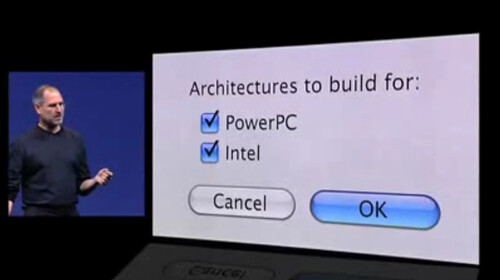
Next was the Mathematica FrontEnd. I normally spend all my time working on the FrontEnd, so this part didn't worry me much. The FrontEnd is built with Xcode, which had a new "architectures" setting checkbox. We checked the checkbox for the Intel architecture (actually, we didn't because Intel was the default target architecture when building on Intel... but we did verify the checkbox was properly set). Within 4-5 minutes the FrontEnd built with only a couple of minor build errors which were easily fixable. After 10 minutes working on the FE we had it built and running. It wasn't running flawlessly, but it was a very good start. I had only been at the secret Intel machine for around a half hour. This was getting really exciting.
The next step was the one which caused me the most concern, the Mathematica Kernel. The reason for my concern was that I don't often work with the Kernel. I knew how to build it (the build system is somewhat complicated) and I knew roughly how the code was organized, but there are all sorts of minor details which could really slow down the process. It relies on many external libraries (open source and commercial) and custom build tools. Fortunately, the Kernel, like MathLink, already ran on Mac OS X PowerPC and Intel Linux & Windows. It took a while longer to figure out some of the proper build flags, and some of the build errors weren't entirely obvious.
This is where Matt, Eric, & Ronnie really came through. They had each spent a lot of time porting open source applications to Mac OS X Intel to learn what types of issues developers might run into along the way. Each time we encountered some sort of problem in an open source library one of them would go off on their own for a few minutes to resolve the problem while the rest of us kept hammering away. Every few minutes we would get further and further along in the build process with new issues popping up all the time. It was like an assembly line. In parallel.
After about 90 minutes (2 hours from when I entered the room) we had the Kernel running, the FrontEnd running, and the two processes were able to talk to each other through MathLink. Again, it wasn't perfect, but nearly everything just worked.
News spread up the ranks. Within minutes we had high level executives stopping by to see the first 3rd party commercial application running on Mac OS X Intel. By early evening Theo (who took a later flight) arrived frantically asking what he can do to help. He was a bit shocked, and very pleasantly surprised, that it was mostly done.
Friday we worked to fix bugs and showed off the software to an ever growing number of people. Since Mathematica already ran on Intel processors on other platforms, most of our cross platform code was byte order agnostic. There were a few cases where Mac specific code was assuming big endian byte order, particularly related to Quartz (bitmap drawing) and OpenGL. There were also some issues with Quickdraw PICT drawing.
Friday evening some of the Mac rumorssites (original CNET article appears to have been removed) reported that Apple would be announcing the switch to Intel processors at Monday's keynote. Rumors like this had been published for years, so it wasn't that out of the ordinary, but this report was different. It contained many specific (correct) details rather than just wild speculation (like every previous report like this). It was clear someone in the know had blabbed. The conference room was silent for a few moments. Oh well. Until Monday, it's still just a rumor.
Saturday morning we drove up to San Francisco to prepare for the WWDC keynote. We had a rehearsal where I met and shook hands with Steve Jobs. I had heard horror stories about his temper, but he was in a great mood when I met him... sitting perfectly relaxed, legs crossed, smile from ear to ear. I could tell he was excited.
Theo practiced his speech, asking Jobs for feedback along the way. The funny thing was that Steve was so happy he kept telling Theo "say whatever you want" or "talk for as long as you want." Meanwhile I set up the demo machine (and backup demo machine) with our freshly built Mathematica for Mac OS X Intel.
Monday morning before the keynote Theo & I hung out in the VIP lounge. Woz (Steve Wozniak, the other co-founder of Apple) was there, Sergey Brin (co-founder of Google and former Wolfram Research intern) was there, along with many other influential people in technology.
Once the keynote started we sat in the front row on the far right side. Midway through the keynote Jobs called us up to the stage. Theo described our experience porting Mathematica to Mac OS X Intel over the previous few days. I drove the demo machine as he talked. It was a big hit. Theo captivated the audience. At one point Theo mentioned my name, which immediately caused 4,000 people to turn their heads to stare at me. It was a little awkward (which is quite evident in the video). Had I known that was going to happen I think I could have played it a little more cool. Anyway the demo was a success. Mission accomplished.
Note that a few minutes of the demo were edited out of this video for some reason.
That wasn't all for that WWDC. On Tuesday I gave a 10 minute presentation during Bud's science session about Mathematica on Mac OS X, detailing how we utilize various OS features. This went more smoothly for me as I had actually been preparing for it for a few weeks. Later that week I spoke about Mathematica for a minute or two in Ernie's 64-bit session. I went from participating in zero sessions my first four WWDC's to three sessions in 2005, back to zero sessions every year since. Perhaps that was my 15 minutes of geek fame (actually, the total time I spent on stage was almost exactly 15 minutes).
Last year I attended a reunion for the non-profit organization where I worked in college, ASP. A guy who I hadn't seen in 8 years came up to me and asked me if I was in a Steve Jobs keynote a few years ago. "I thought that was you..."
Anyway, tomorrow's 2009 WWDC keynote won't be as exciting for me, though I'm sure it will still be exciting. I won't be participating in the keynote. At least, if I am they haven't told me yet. Always with the secrecy.
This Memorial Day weekend flew by. We got a lot accomplished, but not as much as we had hoped. I can't help but feel partly responsible.
I had Friday and Monday off work, which is pretty rare. I celebrated by sitting around in my underwear until noon or so on Friday. I followed that up with my first post-marathon run, five miles easy. It went well. I had some tight muscles with a few aches, but no major injuries. I spent most of the afternoon mowing the lawn and doing other miscellaneous yard work. In the evening we went to Target to look at baby items.
Kickapoo mountain bike trails
Saturday morning I mountain biked at Kickapoo with Gene and Greg. I haven't been there in a few months, so I wasn't quite at the top of my game. The trails were a little muddy, but not nearly as bad as they could have been. Gene and Greg took me onto the "new" section of trail, which was absolutely ridiculous. Most of the trail is challenging, but this new part was downright sadistic. The single track trail was very narrow (18"?), cut into the side of a very steep hill, slanted downward, with tight and steep switchbacks. I made it through okay. Actually, it was dangerous. There, I said it. The rest of the trail pales in comparison.
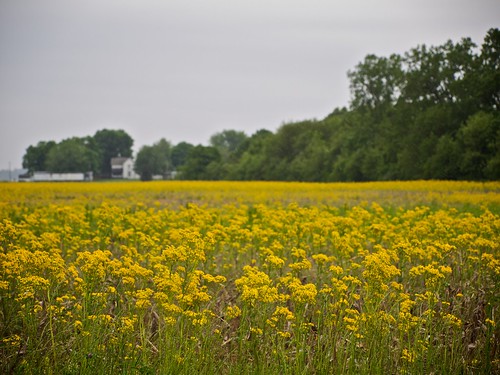
Many unplowed fields across Illinois and Indiana had bright yellow flowering plants (which I assume are weeds) this weekend.
Saturday afternoon we drove to Indianapolis. First we visited Babies-R-Us to look at cribs and other various items. Next we went to Aimee & Brett's house to pick up a few baby items they wanted to give us. Then it was on to Aunt Jeanne's house to meet up with the family. Finally, we went to Zionsville to my uncle Dennis and (new) aunt Sally's wedding reception (the main event of the trip). The reception went well, and it was great to catch up with the cousins, aunts, & uncles. Sally is a wonderful woman and she and Dennis seem very happy together.
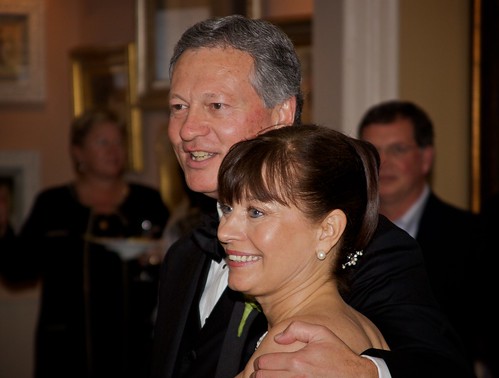
newly married Dennis and Sally
Sunday morning I got a little cleaning done in the office, but not as much as I (or Melissa) hoped. It's never as much as I hope. I also worked for a little while setting up one of my old computers for my grandparents in Bismarck. After lunch we went swimming (our first family swim). Then we went shopping for new stoves. We've been on the brink of getting a new stove since Christmas. I think it's finally going to happen this week.
Danville National Cemetery at the VA on Memorial Day
Monday morning I drove over to Danville for the Memorial Day 5K race at the VA. It rained during the race, which kept the temperature somewhat cool, but also made the roads a little slick. Right from the start a large pack of high schoolers shot out to the front. I tagged onto the back of the pack, maybe 12-15th position for the first half mile. I was running way too fast and I knew it. What were all these jokers doing?
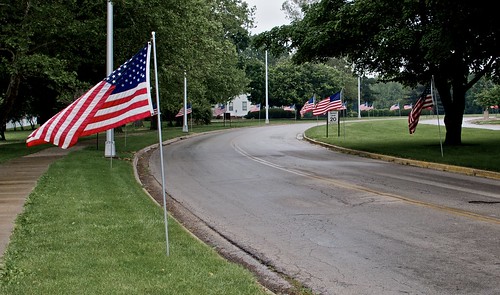
The 5K course followed the road around the VA, which was lined with flags for Memorial Day.
The second half mile I slowed down, but all the kids around me slowed down even more. I moved my way up through the pack. I reached the first mile in 5:36. I ran mile two in 5:50, by which time I had moved into 4th place. My heart rate was through the roof and it was starting to wear on me. The last guy I passed tagged along behind me and stayed with me for the third mile. He passed me back with around a quarter mile left. My last mile was 5:55 and I finished in 5th place (out of a record 398 participants), 1st in my 30-39 age group. I was worried I might still be feeling the effects of the marathon eight days prior, but my legs felt perfectly fine. It was a tough race, mostly because I started too fast (didn't I just learn not to do that?). Well, racing a 5K is a world apart from racing a marathon. Incidentally, my heart rate hit 194 in the last tenth of a mile, which I believe is the highest I've ever recorded (my theoretical max heart rate is 195).
After the race I went to visit my grandparents. They've been having some health problems recently and I hadn't seen them in a few months. They seemed to be doing fairly well, all things considered. My dad and I worked to get their computer problems straightened out. Then we had a pizza lunch before hitting the road. I drove my dad back to Danville in the new car, which he seemed to enjoy.
Finally we spent this evening at a cookout with Cara & John at our house. John got a nifty remote controlled speedboat for his pond. Good times.
The top searches that lead to my blog in March were:
my name is rob
camel clutch
time lapse photography 555 timer circuits
dahon helios
bike friday pocket rocket
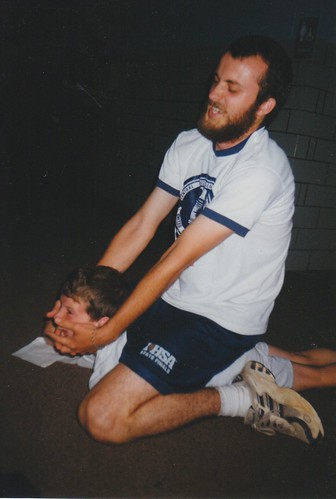
I'll note that my Flickr photo was on the first page of Google results for "camel clutch" and my blog entry was on the second page of results. So I've been getting some pro wrestling traffic.
Other humorous searches include:
$5 camera
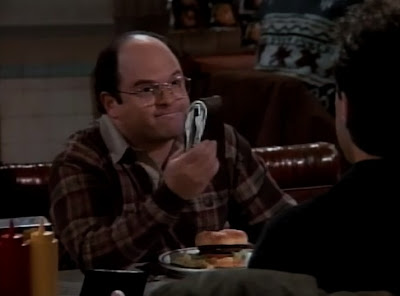
jerry seinfeld hair
steamy novel
5 men walking at same pace riddle
fallking
short shorts boy 1980
Interesting stuff.
Cycling
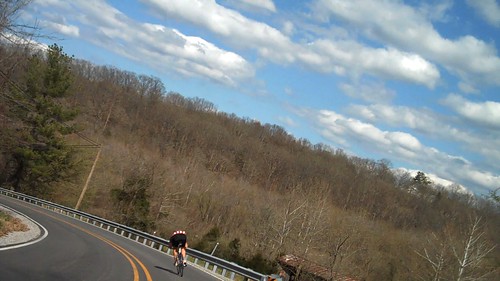
Despite the lousy Smarch weather the past few days, we had some decent weather earlier in the month and I was able to increase my cycling mileage.
I ramped the running mileage back up in March. I had a good race at LBL and I've been doing some good quality training. The marathon is only 11 days away.
Month
Distance
# Workouts
Avg per Workout
January
109.34 Mile
10
10.934 Mile
February
55.83 Mile
7
7.97571 Mile
March
108.792 Mile
10
10.8792 Mile
Total
273.962 Mile
27
10.1467 Mile
Swimming
I wore out my Speedo
I've also been swimming really well lately. I'm able to swim farther and faster than at any other time in recent years. This could mean good things for the upcoming triathlon season.
One of this week's $0.99 movie rentals on iTunes is The Natural. This is the movie that introduced me to the word "bastard" as a child. I had no idea what it meant or even that it could be considered a bad word. I just picked up from the movie that it's something you call someone when you're mad at them.
Of course, this got me into trouble when I called my brother Travis a bastard at a family gathering. Nobody really heard it, but Travis promptly tattled on me and I got my mouth washed out with soap. The worst part was that I had absolutely no idea what I had done wrong.
I'll freely admit that there were plenty of times in my childhood when I truly deserved to have my mouth washed out with soap (though my personal preference was for Lux, I found Palmolive had a nice, piquant after-dinner flavor -- heavy with a touch of mellow smoothness), but this wasn't one of them.
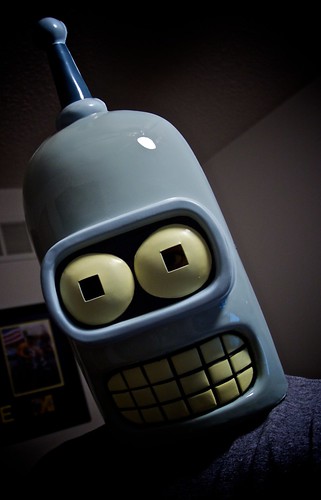
Futurama is one of my all time favorite television shows. The robot character Bender isn't my favorite character on the show, but he seems to be quite popular with every other fan of the show. I was able to score this Bender halloween mask from emerchandise.com in 2002 for $7 and it has served as my de facto Halloween costume many times since then.
I rode my bike to several different places on the course to cheer her on and take pictures.
The marathon went rather well for Melissa, and as a result, less well for me. For you see, she ran so fast that half of the places where I went to watch the race I arrived too late and missed her. The first time it was clear that she had already passed so I didn't wait around long. The remaining times I waited several minutes before I could be sure she had already passed.
We were both wearing GPS watches, so using that data I put together this animation using Mathematica that shows our locations throughout the race. Melissa's path is blue, Rob's path is red. It's kind of funny to watch my red path wait around at a certain location while Melissa moves farther and farther away.
Q: Was there a defining moment in your life when you made a decision that changed the course of the rest of your life forever?
A: I walked out of a bar on my 30th birthday and ran 30 miles cold turkey. It hurt bad, but it changed the course of my life ever since that faithful event. -Dean Karnazes (Ultramarathon Man)
Today is my 30th birthday. The Big 3-0. We spent the last two nights partying with friends and family. Today, I spent much of the day running. Inspired by the story of Dean Karnazes, now one of the best endurance runners in the world, I decided to run 30 miles on my 30th birthday. And as if that weren't enough, I also chose to run the 5.5 mile Allerton Parktrail race.
Last night at dinner with my family we reminisced of my first trip to Allerton Park as a young boy with my grandparents, aunt, & brother. My grandmother and aunt talked with disgust about rumors of wild parties & orgies that supposedly took place at the Allerton estate while Robert Allerton was living there decades ago. They then asked me if I knew what an orgy was, to which I (as a 9 or 10 year old) apparently responded, "No, and I don't want to know."
Gardens near finish line
In addition to the beautiful gardens on the grounds, Allerton Park has some of my favorite trails in the area. The only other time I ran the race was 2003. That year I was in very good shape. I ran the entire race in 10th place. Then in the last half mile seven people passed me. This year I am in roughly equally good shape and I hoped to equal or better my previous result.
I arrived early to get in a good warmup (and start working on my 30 for the day). I've run this trail 4 times in the past month, so I knew it fairly well. I was amazed to see how high the water in the Sangamon River was, givin the small amount of rain we had this week. Apparently this river has a very large watershed. The trail was very muddy, and flooded in dozens of places. Most of the flooded areas could be avoided by running to one side of the trail or the other. There were four or five places where the water simply could not be avoided so we had to run through. A few were only ankle deep. One was close to knee deep.
The trail was very muddy, with four or five water crossings
I started the race near the front. I was in 6th place at the first turn when we headed into the woods. I stayed in 6th place almost the entire race. I passed another runner around mile 3 to move into 5th, but that runner passed me back around mile 3.5.
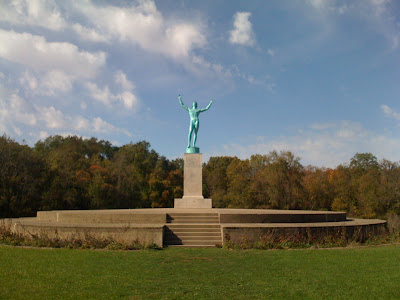
The 5.5 mile race course makes a loop around the Sun Singer statue
With my heart rate over 180, I was really starting to tire by the time we reached the Sun Singer. I generally try not to look behind me in races, but I did at this point and I was kind of glad to have a lead of around 40 seconds over the next runner behind me. From there I eased up a little and cruised the remaining 1.5 miles. I still ran hard, but I tried not to overdo it. I finished in 6th place overall (out of 396 finishers), 2nd place in my new 30-34 age group. I was very happy with the placing. My time was slower than I would have liked, but so was everyone else's time. The trail was really slow today.
Rob finishing the race (photo by Kelly Bails)
I chatted with some friends at the finish line, grabbed some water and bananas, walked back to my car, changed shirt/socks/shoes, and started running again. Very slowly. Along the way I helped out my friends from Second Wind Running Club (who organized the race) by taking down the flagging tape that marked the course as I ran. I cut the loop a little short so I could make it back to the finish line for the awards ceremony. I received a race towel for finishing 2nd in my age group. As I sat on the grass I stretched out quite a bit. Running that hard really left my muscles tight, and by that point I had only run 12 miles.
After the awards I ate more and started running again, still very slowly. It was rather uneventful until mile 22 or so when I started to have a lot of pain in my right hip flexor. I stopped to walk, but that didn't help much. Around that same time Melissa called me on my cell phone to offer moral support, which helped. My plans were in serious jeopardy and I was still 2 miles away from my car. So I walked about a mile. My hip wasn't getting any better. I started running again. I immediately noticed my hip hurt less when I was running than when I was walking. If that wasn't motivation to keeping running I don't know what was.
I limped along at 12 minute per mile pace for the remainder of the run. I passed the imaginary 26.2 mile mark (marathon distance) at 5:09, probably the slowest I've ever covered that distance in five attempts. I've previously done 2 marathons and 2 ultramarathons. Even though this 30 miler wasn't actually a race, I'm probably going to call it an ultramarathon anyway.
Running through the water crossings on the last lap of the 5 mile trail was pretty unpleasant. My feet and been wet for over 5 hours and now they were sopping and I feared I would get blisters. I looked at my watch as I passed 29 miles and realized I could finish under 6 hours if I didn't dally. So I actually picked it up and ran closer to 10 minute pace for the last mile. I finished the 30 miles in 5:59:04.
After the run I hobbled back to the car, took of my wet shoes & socks, and drove 30 miles home barefoot. I shoveled food and gatorade into my mouth the entire way home. I was pleasantly surprised that I was able to stand up without too much difficulty when I got home and my hip no longer hurt at all. Even now, 7 hours later, I'm still able to move around. Tomorrow will be another story though.
This was the farthest I've ever run (I've done 28.4 miles on two occasions) and it hurt. It hurt more than I expected. It was the race that did me in. Had I run slowly the entire time I don't think I would have had as much difficulty. Fortunately, I never bonked, and my muscles never cramped up. Had it not been for the late hip flexor pain (or the water crossings) it would have been a truly delightful day in the woods.
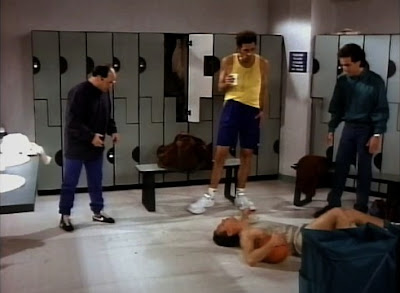
Ralphie: Oooh fuuudge! Ralphie as adult: Only I didn't say "fudge." I said THE word, the big one, the queen-mother of dirty words, the "F-dash-dash-dash" word.
On Saturday I competed in the Charleston Challenge Duathlon. The race wasn't very big, less than 100 participants. The distances (2 mile run, 19.2 mile bike, 2 mile run) suited me fairly well, and I was still near peak fitness from the triathlon national championship race so I liked my chances for success. On the other hand, I heard mixed reviews about this race from friends who have done it in the past. There are half a zillion turns on the bike course and (from what I heard) they are not always marked very well. I know two different people who missed turns on the bike course. One lost a little bit of time, the other lost enough time that he simply abandoned the race.
Charleston, IL is only about an hour away so I didn't have to wake up unbearably early. I arrived at the race venue (an elementary school) with plenty of time to prepare. First they had a children's race (actually three separate races based on age). They ran a lap around the circle drive, the bicycled around the school. It was entertaining. A number of the children still had training wheels on their bikes.
Next was the grownups race. I warmed up a little on the bike, trying to keep my eyes peeled for the orangish markings on the road that denoted the turns. I think I can handle this. I re-racked my bike and went for a short run. I needed to get used to running fast because I wasn't going to have any time to warm up during a race this short.
The race began. I started at the front and went out with the leaders for the first half mile or so. At that point two guys started to pull away. I was in third place. I decided to let them go and keep my pace under control. The course was not marked and I wasn't wearing my GPS, so I had no idea how fast I was going. Sometimes the adrenaline rush at the beginning of the race can mask the sensations you normally use to feel your pace.
My senior year in high school at the conference track meet I ran the first 400 m of the 3200 m run in 62 seconds. I had a 10 second lead on the rest of the pack at the end of that first lap. The rest of the race didn't go so well. I somehow hung on to finish second place, but I really should have won. I learned a valuable lesson that day about starting too fast.
Anyway, I maintained my position the rest of the first run leg. By the end I let the two leaders gain 15-20 seconds on me. The next runners were another 10-15 seconds behind me. I entered the transition area and glanced at my watch, astonished to read 11:08. If the course was accurate I had just run my fastest two miles in 10 years.
I had a quick transition and began the bike a little winded, but feeling good. The road curved through a neighborhood before approaching a stop sign. I lost sight of the leaders through these curves. I race volunteer was standing at the intersection pointing to my left. Hmm. I didn't see any markings on the road indicating this was a turn... I wonder why he is pointing. I looked to my left and saw a pickup truck (who had the legal right of way) coming to a stop. Oh, good. The volunteer was just alerting me to the presence of the truck. Now that the truck is stopped I can continue through the stop sign. The volunteer stared at me as I passed, though he didn't say a word.
As I rode the next couple blocks I began to second guess myself. The road got narrow. I still couldn't see the leaders. Did I just make a wrong turn? I looked back behind me and saw a steady stream of cyclists turning left at that intersection.
Oooh fuuudge!
I slammed on the brakes and turned around as fast as I could. As I reentered the course the same volunteer again stared at me, and again didn't say a word. I was mad. Furious. On the plus side I unleashed that anger on my pedals and rode the next few miles like a man possessed. I quickly passed a slew of riders, nearly everyone who had passed me while I was off the course. I saw one more rider off in the distance and I chased him for miles, over half of the course. We were going almost the exact same speed and I wasn't gaining much. The course turned. We went uphill, downhill, uphill, downhill.
About halfway through the bike I could tell he started to slow down and I regained a little motivation as I slowly reeled him in. I made the pass convincingly, but then slowed down a bit. He passed me back on the next downhill. I passed him back on the next uphill. He stayed just a few seconds behind me the rest of the ride. I couldn't see anyone else in front of me and I was beginning to wonder whether I was leading the race. Could it be so?
I finished the bike leg in 53:48, averaging 21.4 mph. I should have ridden faster, even with all the hills, but the numerous turns made it really difficult to maintain a high speed. I reached the second transition with the other guy hot on my heels. I overheard a friend of his tell him he was in 4th place. Crap. I never caught back up with the two leaders. Oh well.
I pulled away from the guy on the run and finished a couple minutes ahead. My second run split was 12:22. My finishing time was 1:18:25, good enough for third place overall.
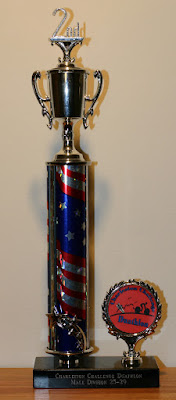
From studying the results I estimate I lost about 45 seconds from the wrong turn. A shame indeed, but the second place finisher was far enough ahead that it wouldn't have made any difference. So I let it be. I was also second place in my age group, for which I won a major award (er, a large trophy). Frankly, I'm kind of glad I didn't pick up the 1st place trophy... it was way too big.
The Iron Coder competition from the recent C4[2] conference I attended had a required API (iPhone OS's CoreLocation) and a theme (paranoia). I actually did take a couple hours on Sunday morning to throw together a submission. Sure, it wasn't going to be polished, but still creative perhaps. I figured several people would do something like a crime map. I tried a variant on that, dealing only with one (particularly nasty) type of crime.
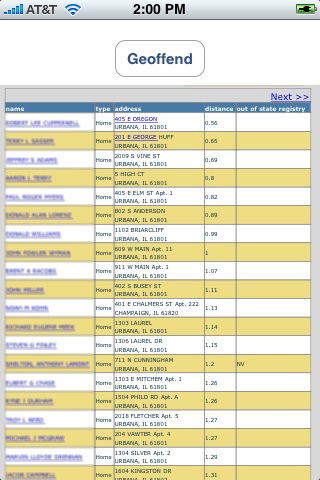
The app I threw together is quite simple. You press the "Geoffend" button. The app determines your location from the iPhone's built in GPS. The app fetches from the internet and displays a list of registered sex offenders who live near your current location. If that doesn't induce paranoia, I don't know what will. I call it Geoffender (combining Geo with offender).
I got the app working in the iPhone simulator on my computer, but I ran into problems running the app on my actual iPhone hardware. I recently acquired a new iPhone, and I hadn't yet set it up for development. When I tried to set it up before the contest I absolutely could not get it working. I tried everything. The iPhone platform is pretty well locked down. In order to do development you have to have various digital certificates and keys from Apple. I have these. The problem is installing them correctly is not completely straightforward. So the demo was a no go.
It's just as well. There were many other submissions to the contest which were much better. I also learned a few things, so the time wasn't wasted.
Homer Simpson: "I like pizza. I like bagels. I like hot dogs with mustard and beer. I'll eat eggplant. I could even eat a baby deer. La la la la la la la la la la. Who's that baby deer on the lawn"
As some C4 attendees are complaining on Twitter, ordering the right kinds of pizza for a group of people presents challenges. There are people who like meat. There are people who like veggies. Some of the meat eaters won't eat veggie pizza. Some of the veggie eaters won't eat meat pizza.
In this particular case there was apparently an abundance of veggie pizza and not enough meat. That's unfortunate for some. On the flip side, I cannot even begin to tell you how many times I've eaten pizza in a group who has ordered all meat pizzas, except for one cheese, and everybody goes straight for the cheese... leaving a hungry vegetarian and a bunch of uneaten meat pizza. This has happened to me literally dozens of times in the past 10 years (mostly in college).
The solution to the pizza dilemma is obvious, yet people often get it wrong. Order fewer meat pizzas and fewer veggie pizzas, while adding a boat load of plain cheese pizza. Sure, cheese may not be the favorite of some meat eaters or some veggie eaters, but they will eat it. Some may argue they won't... but those people are wrong.
So instead of running out of meat pizzas and having meat eaters go away hungry, or (as is more often the case) running out of veggie pizzas and having the veggie eaters go away hungry, everyone will be able to eat cheese when their favorites run out and nobody goes away hungry.
Our last name is terrible. Every email I've sent for the past five years has included a phonetic pronunciation of our name, yet nobody can pronounce it. Nobody can spell it. Crappy computer systems from the 1970's (like those used by airlines, credit card companies, etc) don't allow enough space (16 letters), nor do they allow hyphens (nor even spaces), so it all gets squished together and chopped off at the end.
When we would go to restaurants and give our name to the host[ess] to be seated it took more time to explain the name and how to spell it correctly than it did for a table to open up. At some point we got so frustrated that when we went to a restaurant we just started using the names of people we know. Then we started using random names. The problem with this is that we actually had to remember which name we used on which occasion. It was simpler to use the same name each time... but what name would it be? It had to be easy to spell & pronounce, like Jones. But we wanted something a little more unique (and perhaps a bit silly).
We settled on McJones.
I'm pretty good at keeping a straight face, but I nearly lost it the first time we used this name at a restaurant. It's just such a ridiculous name, yet it met all our criteria. We've been using it for four or five years now, and it never fails to provide us with amusement.
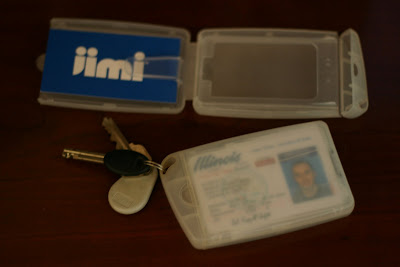
When we returned to the U.S. last August I purchased one of the greatest things, the Jimi. The Jimi is the "wallet for people who hate wallets." It's a fabulous, tiny, semi-waterproof, plastic wallet that's just big enough to hold identification, credit card, insurance card, and a couple bills. Tack on a key chain containing the only keys one ever needs (home, office, bike lock), and you're good to go. It fits nicely into a bike jersey pocket, and it doesn't matter if it gets sweaty (I sweat more than any other human).
Wherever I go I get comments on it, like "That's a neat wallet." My typical response is, "It keeps me from carrying too much crap around."
an unsuitable wallet
For the past few months it hasn't been closing all the way along the sides. More recently the plastic hinges on both sides started to rip. There's not much left to them. It would probably last another week before completely falling apart.
Jimmy's down!
Thankfully, I ordered a new one and it just arrived today. Hopefully this new one will last me another year before giving up the ghost.
Last weekend in West Lafayette, IN some friends and I participated in a bike race. Actually, it was three separate bike races which together formed a stage race. My Wild Card cycling team had 6 riders in the cat 4-5 race: Thomas, Luke, Mark, Karl, Dan, and Rob.
The Criterium
The first stage on Saturday was a criterium in a residential neighborhood near the campus of Purdue University. Criterium races are okay, but they're definitely my least favorite. The idea is that the course is very short and racers ride several laps around the course for a set period of time. After the set period of time the first person to cross the finish line is the winner. Crits are generally very fast with lots of turning in close proximity to other riders, so there's a little bit more danger involved. Perhaps danger isn't the best word. There's just more possibility for mistakes, both by you and the other riders.
On the bright side the roads are closed to traffic. Err, uh, at least they're supposed to be. After warming up a little we were informed that the race organizers were having some traffic control problems. First, the course was going to be shortened by half, leaving only a 0.6 mile loop. Second, a couple of the roads were going to be open to traffic!
In the words of GOB Bluth, COME ON!
As we lined up to start the race the officiant explained a few rules. He explicitly stated that riders who get lapped should stay to the far right of the road so as not to interfere with the lead riders. Fine.
The race started. There were 57 riders. Now on narrow residential streets that may or may not be open to traffic, we could really only ride three or four wide across the road. This meant there was a huge distance from the first riders to the last riders at the start, probably a quarter mile. The fastest riders only needed to gain maybe a third of a mile to lap the slowest riders. That's exactly what happened, and it didn't take long.
I started a little conservatively in the middle of the pack. The lap had a short steep hill (which was to my advantage), then a long downhill with a sharp turn at the bottom (which was to my disadvantage). I passed around four or five riders each lap for about 24 minutes of the 35 minute race. The leaders were still well ahead of me and were close to catching up and lapping me.
When I finished the lap it sounded like the race directors yelled at me (as well as everyone else) to get off the course. What? The next lap they did the same thing. The pace car passed me and the lead rider was not too far behind so I moved over to the right. When I finished that lap I heard more clearly what the directors were saying, and indeed they told me to get off the course. I stopped (many other riders had already stopped) and asked one of my Wild Card teammates what was going on. Apparently they wanted all lapped riders off the course (I actually hadn't been lapped yet). Okay, I guess, but that wasn't what they told us before the race. Why on earth did they change their minds in the middle of the race? I guess I'll never know. Only 13 riders remained in the race until the finish. My teammate Thomas finished 2nd in the final sprint. Kudos to him.
I apparently tied for 17th place with every other rider who was pulled on the same lap. Since this was a stage race the finishing time actually did matter, so there was some confusion how this was going to work when the majority of riders didn't actually finish. The organizers prorated the finishing times. I was a little over one minute behind the leader after 24 minutes of racing. Worst case scenario I would have been two minutes behind after 35 minutes of racing. So my prorated time was... 5:21 back.
Whatever.
The prorating was equally bad for everyone, so it's not really worth getting too upset. But lots of people take themselves a little too seriously and there were about 40 super pissed cyclists after that race.
The Road Race
Early the next morning was the road race. The 22 mile race took place mostly on a four mile loop in the country that included a pretty big hill that was clearly going to be decisive. Again, I started in the middle and worked my way up to the top third or so before we reached the hill. Several riders dropped off the back of the group on the climb. The same thing happened the next lap, and each lap after.
I stayed with the lead group the whole race. The group was down to 25 or so riders by the last lap. I thought someone might try to escape on the last hill, but the strong headwind at the top prevented that. We approached the finish line as a big group. The pace started to slow, as everyone wanted to conserve energy for the finish. Thomas was again well placed near the front of the group, so I shot to the front and whipped up the pace to lead out the sprint for him. I led for 400 meters or so until the sprint started about 200 meters before the finish. Thomas finished 2nd again, though a different rider won. My teammate Luke was also in the lead group and finished 8th. I rolled across the finish line in 15th. I was much happier with the outcome of this race than I was with the previous race. It was good that I not only stayed with the lead group, but was strong enough at the end to try to help Thomas & Luke finish higher up. I didn't really stand a chance in the sprint anyway.
The Time Trial
Finally, on Sunday afternoon was a 5.8 mile time trial. This is a race where each rider is timed individually, starting 30 seconds apart so they can't work together. The course was the same as part of the road race, and it included the same big hill. As an experienced triathlete I generally enjoy time trials (which are identical to the bike portion of a triathlon). I also enjoy riding on hills. Perfect... except for one thing. Take a guess what that was.
The course was point to point and it was almost entirely into the wind. Heavy riders have a harder time riding uphill than I do. I have a harder time riding into the wind than many others. The reason? Physics. I'm fairly big/tall and I'm kind of lightweight so I have a high surface area to weight ratio. Higher surface area causes more wind resistance. Lower weight (mass) means less momentum one can use to counter this effect. I shouldn't make excuses, but when it's related to physics I can hardly resist...
I rode reasonably well, but not as fast as I would have liked. I tied for 19th place. I averaged around 21 mph into the wind, while the winner averaged around 24 mph. Thomas also tied for 19th, and Luke was 13 seconds faster in 15th place.
The General Classification
Since the time gaps between the riders were not that large after the criterium and the road race, the time trial results pretty much determined the final overall stage race results. Here's how the team did:
Thomas
11th
Luke
12th
Rob
15th
Mark
29th
Karl
39th
Dan
46th
We were not quite as dominant as we were in Hillsboro, but we had a solid race.
Homer: Hmm. I wonder why he's so eager to go to the garage? Moe: The "garage"? Hey fellas, the "garage"! Well, ooh la di da, Mr. French Man. Homer: Well what do you call it? Moe: A car hole!
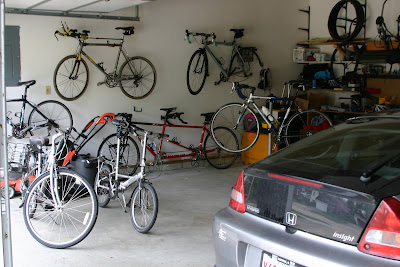
Since watching this episode of the Simpsons (The Springfield Connection) I have frequently referred to our garage as a car hole. It wasn't until more recently that I realized our car is seriously outnumbered by bikes, and under the circumstances it would be more accurate to call it a bike hole.
Anyway, I spent most of the day Saturday cleaning the bike hole (including unpacking a few boxes that have been sitting in the middle of the floor since we moved in last August).